

Back-to-Back Game Nights: Keep the Tap List Right
To keep the tap list right across back-to-back game nights, close each night with a written keg count and open the next day with a reset that puts cold backups on the kicked taps under the same tap numbers. The count travels on the handoff card from Friday's close to Saturday's open, and again into Sunday.
Below: the count, the keg and chill math, the reset, a 2 night special, the handoff, the website and Sunday's 3 viewing windows.
Why does the second game night go wrong on the board?
The second game night goes wrong because it opens on a board set up for the first night and then run hard through a full game. For example, a 16 tap sports bar can carry all of this into Saturday:
- A line still marked kicked, though its backup went on 10 minutes later.
- No backup for that tap tomorrow, because the prep sheet's backup is now on the line.
- Keg levels from Friday's pre-open count.
- The rush layout or the game special, still up.
Game night keg prep gets 1 night ready from 2 days out, and the rush layout for a packed bar handles the hours inside that night. A weekend with games on 2 or 3 nights running adds the hours in between, often with a different person on the board.
What should the closing count cover after a game night?
The closing count after a game night covers every tap: what kicked, what is low going into tomorrow and what goes on next, with each keg's level written down before the closer clocks out.
Do it while the person who swapped kegs is still in the building. By morning, nobody remembers whether the backup on tap 1 went on at 8:50 or at 9:30.
Write each level in the unit your board takes, a percent or pours. Setting a low keg mark for each tap covers turning "a bit left" into a number. For example, a Friday count at a 16 tap sports bar, fast movers and changed lines only:
| Tap | Drink | Kicked tonight? | Level at close | Cold backups left | Next on this tap |
|---|---|---|---|---|---|
| 1 | House lager | 8:50 pm, backup tapped | 40% | 1, in the cooler since Wednesday | Same beer |
| 4 | Hazy IPA | No | 25% | 0 | West Coast IPA, due Saturday 10 am |
| 9 | Raspberry sour | 9:15 pm, no backup | 0% | 0 | Pilsner, in the cooler since Thursday |
| 11 | Cider, sixth barrel | No | 50% | 0 | Nothing confirmed |
Slow taps that didn't change get a level and a check mark. Write the cooler time next to every backup, because the chill clock runs from it.
How much beer is left for the second night?
The beer left for the second night is the closing level times the keg's size, divided by the pour size, plus any backup that is already cold. The Brewers Association's Draught Beer Quality Manual lists a half barrel at 15.5 gallons, or 1,984 fluid ounces, which it counts as 165 beers of 12 oz.
At 16 oz, that's 1,984 / 16 = 124 pours before foam and waste. A sixth barrel holds 660 fluid ounces, or 55 beers of 12 oz.
Worked example, from the Friday count above, with Saturday targets made up for example only:
| Tap | Keg and pour | Level at close | Pours left | Cold backups | Saturday target | Result |
|---|---|---|---|---|---|---|
| 1 | Half barrel, 16 oz | 40% | 1,984 x 0.40 / 16 = 49 | 1 x 124 | 150 | 173 pours, covered |
| 4 | Half barrel, 16 oz | 25% | 1,984 x 0.25 / 16 = 31 | 0 | 60 | 29 short |
| 11 | Sixth barrel, 12 oz | 50% | 660 x 0.50 / 12 = 27 | 0 | 30 | 3 short |
Pours left are rounded down and come before foam and waste, so tap 1's 23 spare pours are thinner than they look.
Each short line gets a decision at close. Tap 4 is 29 pours short (about 23% of a keg), and its West Coast IPA probably won't be cold by Saturday night (next section). So either a cold keg from the walk-in goes on tap 4, or tap 4 gets marked kicked when it runs dry. Tap 11 will kick late: write what goes on next, or leave it marked kicked.
Run the same math at Saturday close for Sunday.
Will a Saturday morning delivery be cold by Saturday night?
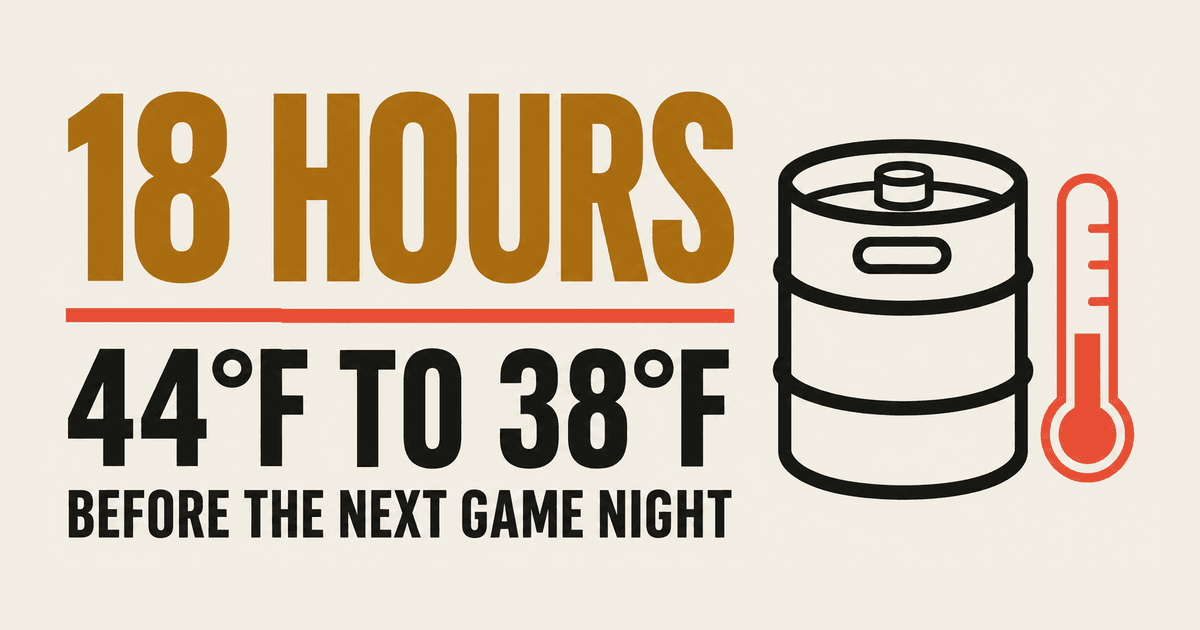
A Saturday morning delivery usually won't be cold by Saturday night's first pour. The Brewers Association's Draught Beer Quality Manual says every keg must be at or below 38°F when served, and that even kegs that feel cold, at 44°F for example, may need to chill overnight.
The manual's chill table, with the clock math for a 10 am Saturday delivery and a 6 pm first pour (both times for example):
| Keg temperature on arrival | Hours to reach 38°F | Cold by | Ready for 6 pm Saturday? |
|---|---|---|---|
| 40°F | 7 | 5 pm Saturday | Yes |
| 44°F | 18 | 4 am Sunday | No |
| 46°F | 21 | 7 am Sunday | No |
| 48°F | 23.5 | 9:30 am Sunday | No |
| 50°F | 25 | 11 am Sunday | No |
If nobody checks a keg's temperature at the door, plan on the 50°F row. That makes the West Coast IPA a Sunday keg.
The same manual says a keg warms from 38°F to 44°F after only 4 or 5 hours at ambient temperature, so don't stage Saturday's backups by the bar at Friday close to save the opener a trip. By morning they need 18 hours or more back in the cooler.
Keep backups in the walk-in, where the manual puts beer storage at 34°F to 38°F.
What goes in the morning reset before the next game?
The morning reset is the opener's walk from the closing count to the board and the handles, done before doors so the board matches tonight's wall. A kick during the game runs on the mid-shift kick routine, and the reset clears what that routine left behind. In order:
- Read the closing count and the handoff card.
- Fix every kicked line: back to normal if its backup went on, replaced or marked kicked if nothing did.
- Move up the backups and replacements (next section).
- Enter the closing level for every tap.
- Take down last night's special and rush layout if they're still up.
- Check the on deck list against the walk-in.
- Pour a small taste from every tap that changed and check it against the board.
- Check the website.
For example, a 20 minute reset on Saturday and Sunday is 40 minutes of wages. The U.S. Bureau of Labor Statistics' Occupational Outlook Handbook puts the median hourly wage for bartenders at $16.51 in May 2025, so that's 40 / 60 x $16.51 = $11.01, less than 2 pints at an example $8.
How do you move backups up without renumbering the wall?
Move backups up by keeping every tap number where it is and changing only the drink behind it. A backup of the same beer goes on its own tap. A different beer takes the kicked tap's number with a full new line (maker, beer, style, ABV, pours and prices), and no other line shifts to fill a gap.
Servers order by number from the floor, and regulars have learned the numbers by the second night. The count, the sub map and the handoff card all say "tap 9," so renumbering mid-weekend makes all of them wrong at once.
If your board is sorted by style, the pilsner going on tap 9 lands among the sours. Move the line to the lagers if you like, but it keeps the number 9, because that's the handle it pours from.
Numbering the handles on a 30 to 40 tap wall covers matching handles and board. When an on deck beer goes on, take its on deck line down in the same edit.
How do you price a 2 night special without a price fight?
Price a 2 night special from 1 card that gives each night's start and end minute, the covered pours with final prices, and what happens when a covered keg kicks between nights. "Game special all weekend" is how a guest ends up arguing over a $6 pint at 1 pm Saturday, hours before the game.
For example:
| Card line | Friday | Saturday |
|---|---|---|
| Window | 7:00 to 10:30 pm | 6:00 to 9:30 pm |
| House lager, 16 oz | $6 (reg $7) | $6 (reg $7) |
| If tap 1 kicks | Same beer's backup, same price | Same beer's backup, same price |
| Board back to regular at | 10:29 pm | 9:29 pm |
The special comes off the board at its end minute each night, so Saturday's opener never inherits a Friday price. If a different beer replaces a covered keg, the card says whether the special follows the tap or the beer.
Running a happy hour special without price fights covers the floor check against beer cost, state rules and ending on the minute.
What does the opener need from the closer's handoff card?
The opener needs the backups already used, every line still wrong, what arrives today and when it will be cold, and whether the special and rush layout came down. Those go on the handoff card, because the Saturday opener often wasn't there Friday night.
The U.S. Bureau of Labor Statistics' Occupational Outlook Handbook for bartenders says bartenders often work late evenings, weekends and holidays, and that part-time work is common and schedules may vary. Add a game weekend block to your shift handoff card:
- Backups used tonight, and cold backups left, with the time each went in the cooler.
- Deliveries due tomorrow, with the time each will be cold.
- Short lines from the count, and the replacement for each.
- Special off at its end minute, and full layout back up: Y or N for each.
The opener signs after checking those lines against the board and the walk-in. Any N is the first fix of the reset.
How do you keep the website and the screens saying the same thing?
Keep the website and the screens saying the same thing by making the website check the last step of every morning reset on a game weekend. A guest picking where to watch the game may read your site first, and a Friday kick still listed there brings them in for a beer you can't pour.
The chill clock applies online too: the West Coast IPA arriving Saturday morning is a Sunday beer, so the site should say Sunday. Keeping a website tap list current has the full check. Whoever holds your website login makes those changes, so put that name on the handoff card for each morning.
How do you run a Sunday board across 3 viewing windows?
Run a Sunday with an early game, an afternoon game and a night game as 3 short services, with a quick count and a board check in each break. A board set at the morning open and left alone has been through 2 rushes, and maybe a crew change, by the night game.
For example, with a 10 minute count at each break:
| Window | Before it starts | Who runs it |
|---|---|---|
| The early game | The full reset from Saturday's count | The opener |
| The afternoon game | Count, fix kicks, move cold backups up, end the early special | Morning board owner |
| The night game | Count, add kegs that are now cold, change the layout if needed | Afternoon board owner |
The chill clock decides which window a late keg joins. A keg delivered at 10 am Saturday at 50°F is cold at 11 am Sunday, so if doors for the early game open before 11, write "afternoon" next to it on the Sunday sheet.
At each crew change, hand off the short version: backups used, lines still wrong, special on or off. Then write each fast mover's pours for each night on Sunday's closing count, so the next game weekend starts from real numbers.
What changes on a digital board over a game weekend?
A digital board turns each fix in the reset into an edit from behind the bar, while the count, the chill clock and the handoff stay on paper. On a TapDisplay board, you change the board from a phone, a tablet or a computer, and each connected screen checks for changes every 30 seconds, so an edit shows within about 30 seconds.
Keg levels are typed by hand from 0 to 100, so the closing count's percentages go straight in. A drink at 0, or marked kicked, stays on the board struck through, labeled KICKED on keg menus or SOLD OUT on other menus, with the word set by the business type.
For Sunday, each screen can show its own sections, and the activity log shows who changed what on Friday night.
The bottom line
On a back-to-back game weekend, each night opens on whatever the last close left behind. Write a keg count at close and have the opener reset the board from it before doors, moving cold backups onto the kicked taps under the same numbers. Check every delivery against the chill table, since a keg at 44°F needs 18 hours to reach 38°F, and on Sunday repeat the count in each break between games.
Questions operators ask next
Should I order backups for both game nights at once?
Order backups for both game nights together when your distributor can, so the second night's kegs arrive with the first night's, or by the day before the second game at the latest. The Brewers Association's Draught Beer Quality Manual gives a keg at 50°F 25 hours to reach 38°F, so a keg that lands the morning of a game is usually cold the next day. Keep every backup in the walk-in until it goes on a coupler.
What if the closer didn't write a keg count?
The opener runs the keg count before doors, fast movers first, and treats the levels on the board as unchecked until it's done, since they may still be from the last pre-open. Lift or weigh each fast mover, write the level in the unit your board uses, and check the walk-in for the backups that are left. Put the missed count on the handoff card as an open item so the manager sees it.
Should a beer that kicked Friday still show on Saturday's board?
A beer that kicked Friday stays on Saturday's board only if your house rule keeps kicked lines up and nothing is going on that tap yet. If a replacement is cold, put its full line on the kicked tap's number before doors. If the tap stays empty, mark the old line kicked or take it down. An unmarked line left from Friday tells Saturday's guests the beer is still pouring.
How many pours are in a quarter barrel or a sixth barrel?
The Brewers Association's Draught Beer Quality Manual lists a quarter barrel at 7.75 gallons, or 992 fluid ounces, which it counts as 82 beers of 12 oz. It lists a sixth barrel at 5.16 gallons, or 660 fluid ounces, counted as 55 beers of 12 oz. At 16 oz, a quarter barrel is 992 / 16 = 62 pours. Those counts come before foam and waste, so plan on fewer.
Sources
- Draught Beer Quality Manual. Brewers Association, accessed October 18, 2026.
- Bartenders, Occupational Outlook Handbook. U.S. Bureau of Labor Statistics, accessed October 18, 2026.